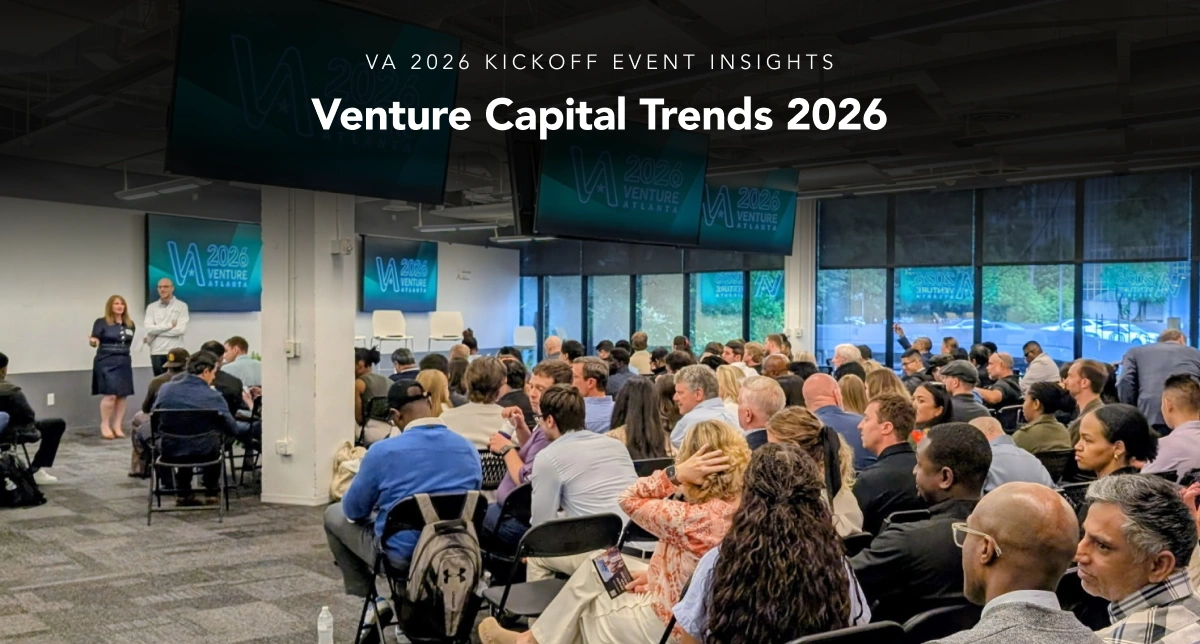
Our annual Kickoff Event officially launched the road to Venture Atlanta 2026! The sold-out event brought together founders, investors, sponsors, board members, and community leaders for an evening focused on what is next for the Southeast’s startup ecosystem.
This year’s conversations covered two big questions shaping the venture capital trends of 2026:
- How are founders building and exiting in a slower liquidity market?
- And where is capital moving as investors look beyond traditional software?
From Josh Levy’s story of building Document Crunch through its acquisition by Trimble to a forward-looking panel on frontier tech, space, defense, hardware, and physical AI, the kickoff made one thing clear: Atlanta is ready to play a bigger role in the next wave of innovation.
As Venture Atlanta enters its 19th year, founders are just as hungry to build, investors are still looking for standout companies, and the Atlanta startup ecosystem has incredible momentum heading into October. Here’s what you missed:
What the Kickoff Says About the Venture Capital Outlook for 2026
The venture capital outlook for 2026 is being shaped by several growing industries and trends happening at once:
- Founders are building in a more disciplined market
- Investors are looking for stronger fundamentals
- AI is creating new opportunities, but companies still need to show real differentiation
- Exits are still possible, but buyers are more selective
- Capital is also moving into industries that were once considered too complex, too physical, or too slow for traditional venture capital
Today’s venture market is more practical, more technical, and more grounded in real customer problems. And lucky for founders and investors, the Southeast is ready for all of it.
Keep reading to get a play-by-play of what both panels covered at the event, along with insider information on the pitch application process for this year’s conference.
Panel 1: Building Through Conviction, Lessons From Document Crunch
The first major conversation about the venture capital trends of 2026 focused on founder resilience, AI, and exits.
Moderated by Laney Lewis, Partner at TTV Capital, the panel featured Josh Levy (VA2024), Founder and CEO of Document Crunch, who shared the story behind the company’s growth and recent acquisition by Trimble.
How Did Document Crunch Start?
Before founding Document Crunch, Levy was a construction attorney. He saw firsthand how construction teams were expected to manage risk in complex contracts without tools built for the pace and pressure of the jobsite.
“No one’s given them a hard hat for how to apply knowledge around the contracts.”
— Josh Levy, Founder and CEO of Document Crunch
That observation became the foundation for Document Crunch, a risk intelligence platform built for the construction industry.
Levy didn’t start the company due to AI hype. Instead, he created Document Crunch to solve an industry problem: construction projects are risky, disputes are costly, and the people making daily decisions need better access to contract intelligence.
Why Was AI the Tool, Not the Whole Story?
One of Levy’s strongest takeaways was that technology alone was never the mission.
“The technology has never been that important to me. But I knew that it was a means to help solve the problem.”
— Josh Levy, Founder and CEO of Document Crunch
In a market shaped by fast-moving AI investment cycles, Investors are looking for companies that use AI to solve specific, expensive, recurring problems.
For Document Crunch, AI helped construction teams better understand risk, reduce disputes, and make faster decisions. The company’s focus on a clear industry pain point helped it stand out and ultimately led to the Trimble acquisition.
What Did Josh Levy Say About Founder Conviction?
Levy was candid about the early days. He didn’t leave his role as a lawyer immediately. He built the company in stages, balancing family, risk, and doubt while learning how to become a software CEO.
“We just inch by inch, day by day, kind of built this thing.”
— Josh Levy, Founder and CEO of Document Crunch
It’s important to remember that startup stories are often oversimplified. The beginning gets romanticized, and the exit gets celebrated.
But most of the work happens during the uncertainty of the middle.
“This is really hard, and it takes a lot of conviction. I had conviction in the idea, but I had zero conviction in my ability to execute as a software CEO. I had to build that over time.”
— Josh Levy, Founder and CEO of Document Crunch
For founders thinking about a startup exit in uncertain markets, conviction is more than optimism. It is the discipline to stay close to the customer, keep building through hard moments, and prove value over time.
What Can Founders Learn from the Trimble Acquisition?
The Document Crunch Trimble acquisition became one of the evening’s strongest case studies in strategic fit.
Levy explained that in the AI era, three advantages would matter most to the company’s next phase:
- Product velocity
- Distribution
- Data
Trimble brought deep industry distribution, strategic alignment, and the ability to help Document Crunch continue building faster. Levy also emphasized the importance of culture, team, and whether the acquirer was the right home for employees and customers.
That is a valuable lesson in founder exit strategy. In a slower M&A environment, founders need both buyer interest and a partner who can strengthen the company’s next chapter.
How Can Founders Navigate a Slower Exit Market?
Liquidity has been harder to come by in recent years, but Levy’s story showed that strong exits are still possible when companies build value at the infrastructure level.
His approach to fundraising reflected that mindset. He did not always choose the highest valuation. Instead, he looked for investor alignment, long-term trust, and optionality.
That’s an important skill set for founders navigating the M&A slowdown. The best path to an exit is not always maximizing the current round. Sometimes, it’s building a healthier company, choosing better partners, and preserving room for the right outcome later.
In a market where liquidity in venture capital is more selective, that kind of discipline can become a major advantage.
Why People-First Leadership Matters
The most emotional part of the panel came when Levy talked about his team.
“If you build a movement, magic happens.”
— Josh Levy, Founder and CEO of Document Crunch
When Document Crunch was acquired, Levy worked to make sure employees were taken care of. He shared that every employee received more than they were entitled to and that the team was better off after the acquisition.
Building a company around your people and keeping their well-being at the forefront will always matter just as much as the exit itself.
What Founders Should Know About Pitching at Venture Atlanta
After the Document Crunch panel, Joe Berklund of Gunderson Dettmer and Brian Hamm of Bennett Thrasher shared updates on the Venture Atlanta pitch process.
Their biggest piece of advice: APPLY EARLY!
Venture Atlanta’s selection committee is looking for companies across three tracks:
- Seed stage
- Early stage
- Growth stage
The committee evaluates companies based on stage, market, traction, team, investor fit, and growth potential.
For later-stage companies, that may mean:
- Growth rate
- Capital efficiency
- Margins
- Burn rate
For earlier-stage companies, it may mean:
- Early customers
- Product-market fit
- A repeatable model
- Total addressable market (TAM)
For seed-stage companies, team strength and market potential matter even more.
At every stage, the strongest applicants are the ones that match what investors are coming to Venture Atlanta to find.
Don’t wait until the last day! Early applications give the selection committee more time to understand the company beyond the numbers. Applications open May 18th for the 2026 conference season!
Panel 2: The Return of Hard Tech, Deep Tech, and Frontier Tech
The second panel shifted the conversation from exits to what investors are backing next.
Moderated by Jack Semrau of Socium Ventures by Cox Enterprises, the panel featured Brad Pruente, Partner at Lightcone Ventures, and Theo Williams III, Partner at Creations VC.
Together, they explored one of the biggest venture capital trends of 2026: capital is moving beyond pure software and into the physical world.
What Is Frontier Tech?
Frontier tech investing focuses on companies building in complex, high-impact sectors like space, defense, energy, semiconductors, robotics, advanced manufacturing, and physical AI.
These companies often take longer to build than traditional software startups, but they can also create strong advantages through intellectual property, specialized expertise, real-world deployment, and large market demand.
For the Southeast, that is an incredible opportunity. Atlanta and the broader region have deep ties to logistics, manufacturing, aerospace, energy, supply chain, and industrial customers. Those strengths make the region a natural fit for the next phase of deep tech investment trends.
What Are Early-Stage Deep Tech Investors Looking For?
Williams explained that his firm invests early, often before a company looks obvious to the broader market.
“We will write your first check when it still seems absolutely crazy.”
— Theo Williams III, General Partner at Creations VC
That early-stage thesis centers on real intellectual property, university research, early customer signals, and companies that may start in space but expand into much larger markets.
In frontier tech investing, a bold idea still needs technical depth, a clear customer path, and a reason the company can become hard to compete with.
What Are Growth-Stage Deep Tech Investors Looking For?
Pruente described a later-stage view. His firm looks for companies that have moved beyond pilots and early experiments.
“We’re looking for post-revenue and specifically…the product version of the thing deployed in the real world.”
— Brad Pruente, Lightcone Ventures
For growth-stage investors, the product needs to work beyond the lab; customers need to be using it, and the company needs to show it can scale.
That is where capital reallocation in deep tech becomes especially relevant. Venture capital is still looking for growth, but more investors are willing to back companies that combine software, hardware, data, and infrastructure when the market is large and the proof points are strong.
Why Are Investors Moving Beyond Software?
For years, software companies defined venture capital. They were fast to launch, easy to scale, and familiar to investors.
The next cycle is expanding that playbook.
AI is driving demand for chips, data centers, energy, automation, robotics, and new infrastructure.
On top of that, supply chains are being rethought, defense and space are becoming more commercially relevant, manufacturing is being modernized, and many large industries still need better technology built for the physical world.
However, software isn’t going away. More opportunity now sits at the intersection of software, hardware, data, robotics, infrastructure, and domain expertise.
What Does Physical AI Mean for Founders?
Semrau offered a hot take: the biggest investment opportunity may not be building another robot. Instead, it may be building the intelligence layer that makes robots useful.
That includes simulation, vision systems, orchestration, workflow software, and tools that help machines operate in specific environments.
The most valuable company may not be the one building the flashiest robot. It may be the one building the software, data, or intelligence that helps physical automation work in the real world.
Will Every Company Become Space-Enabled?
Williams also shared one of the boldest ideas of the night that inspired many thoughts:
“Every company will become a space company or a space-enabled company over the next 20 years.”
— Theo Williams III, General Partner at Creations VC
At first, that may sound extreme. But GPS, weather data, agriculture, navigation, logistics, communications, medical research, and data infrastructure already rely on space-enabled systems.
That is why space defense semiconductor investing is becoming more relevant to mainstream venture conversations. These sectors are becoming less siloed as they support the infrastructure behind many of the systems companies use every day.
And Atlanta has a role to play in that future. The region has research institutions, corporate partners, industrial customers, and a strong transportation and logistics base. Those assets could help the Atlanta startup ecosystem become a stronger player in frontier tech.
Experience the Southeast’s Energy & Innovation at Venture Atlanta
This year’s kickoff gave the founders a clear look at what the venture capital trends of 2026 and other conversations will center on at this year’s conference: founder discipline, strategic exits, AI, deep tech, frontier tech, investor fit, and the next chapter of Atlanta venture capital.
If you are building, backing, or supporting high-growth companies in the Southeast, Venture Atlanta 2026 is the place to be.
We can’t wait to see you at Venture Atlanta, October 14-15 at the Woodruff Arts Center! Registration is now open at the lowest prices of the season —> Register here.
Pitch applications open May 18th. Make sure to apply early for a better chance at being selected. Your next opportunity starts here!
Frequently Asked Questions
What Is the Venture Atlanta Kickoff Event?
The Venture Atlanta Kickoff Event officially launches the Venture Atlanta season and previews the themes, speakers, and opportunities leading into the October conference. It brings together founders, investors, sponsors, board members, and community leaders from across the Southeast venture ecosystem.
What Were the Biggest Venture Capital Trends Discussed at the 2026 Kickoff?
The biggest venture capital trends of 2026 discussed at the kickoff included founder discipline, slower but still active M&A markets, AI-enabled vertical software, deep tech, frontier tech, hardware, robotics, space, defense, and renewed interest in companies building for the physical world.
How Are Founders Successfully Exiting in a Slow M&A Market?
Founders are successfully exiting in slower markets by building companies with clear strategic value. The Document Crunch Trimble acquisition showed the importance of solving a real industry problem, building a trusted team, choosing aligned investors, and finding an acquirer with the right distribution, data, and cultural fit.
What Did Document Crunch’s Acquisition by Trimble Signal for AI Startups?
The Document Crunch Trimble acquisition showed that AI startups can create meaningful outcomes when they apply AI to specific industry workflows. For Document Crunch, the opportunity was not AI in general. It was using AI to help construction teams understand risk, reduce disputes, and make better decisions.
What Is Frontier Tech Investing?
Frontier tech investing focuses on companies building advanced technologies in areas like space, defense, semiconductors, energy, robotics, advanced manufacturing, and physical AI. These companies often require more technical expertise and longer timelines, but they can create strong advantages in large markets.
Why Are Venture Capital Firms Moving Beyond Software?
Venture firms are moving beyond software investing because many of the next major opportunities involve physical infrastructure, hardware, energy, chips, robotics, and manufacturing. Software is still important, but investors are increasingly interested in companies that combine software with real-world systems.
Which Investors Spoke About Deep Tech and Frontier Tech at the Kickoff?
The frontier tech panel featured Brad Pruente of Lightcone Ventures, Theo Williams III of Creations VC, and Jack Semrau of Socium Ventures by Cox Enterprises. The conversation focused on deep tech investment trends, early-stage and growth-stage capital, physical AI, space-enabled companies, and the Southeast’s opportunity to lead in real-world innovation.
Why Is Atlanta Well-Positioned for the Next Wave of Venture Capital?
Atlanta is well-positioned because the region combines startup talent, major corporations, logistics infrastructure, research institutions, industrial customers, and a strong founder community. Those strengths make the Atlanta startup ecosystem especially relevant as venture capital moves into AI, deep tech, hardware, manufacturing, and other real-world industries.