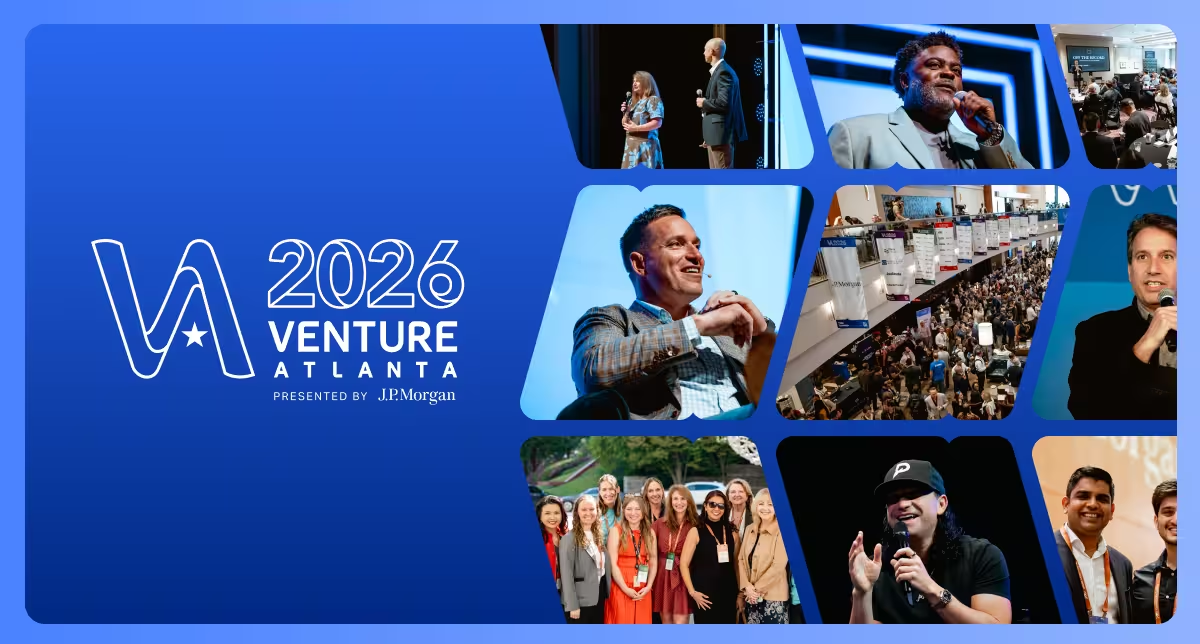
Venture Atlanta 2026 is officially in the books, and it was our biggest conference yet! On October 14th and 15th, the 19th annual conference brought the Southeast’s tech founders, investors, and innovators together at the Woodruff Arts Center for two days of pitches, panels, and connections. We had more attendees, more pitch companies, and more speakers than ever before.
This year also marked a new chapter, with J.P. Morgan as the Title Sponsor of Venture Atlanta 2026. J.P. Morgan has been part of Venture Atlanta for 10 years, and its Innovation Economy team showed up all week: hosting our Hall of Fame Induction, leading a Day 2 panel, and connecting with founders across both days.
Missed the conference? Watch the Venture Atlanta 2026 highlights video below or keep reading this Venture Atlanta 2026 recap for the biggest insights, quotes, and takeaways.
Venture Atlanta Conference 2026 by the Numbers
Here’s a look at the numbers behind this year’s conference, our biggest year yet:
Attendees
- 1,674 attendees (most ever!)
- 500 first-time attendees (most ever!)
- 566 founders (most ever!)
- 70+ speakers (most ever!)
- 120 students
Pitch Companies
- 614 applications to pitch
- 99 selected companies (most ever!)
- 21 sectors represented
- 50 presenting companies
- 64% from outside Georgia (14 states represented)
- 59 seed-stage, 28 early-stage, and 12 growth-stage companies
In almost 20 years, Venture Atlanta has connected more than 1,000 companies to over $8.8 billion in capital, with more than $22.3 billion in successful exits.
The Big Announcement: Venture Atlanta Heads to Cosm for Our 20th Anniversary
We opened Day 1 of Venture Atlanta 2026 with news we’ve been dying to share.
Save the Date: Venture Atlanta 2027, our 20th anniversary conference, is moving to Cosm Atlanta on October 13th and 14th, 2027!
In other VA 2027 news, we welcomed our 2027 Chair, Emery Waddell, General Partner at Vocap Investment Partners. Emery, we are thrilled to have you leading us into our 20th year!
We also want to give a huge thank you to our 2026 Chair, Scott Lopano, Partner at Tech Square Ventures, for leading us through a record-breaking year!
Opening Keynote: Jeb Terry, President & CEO of Cosm
Jeb Terry, President & CEO of Cosm, opened the Venture Atlanta 2026 main stage in conversation with Andrew Davis, SVP of Investments & Managing Partner at Socium Ventures by Cox Enterprises.
Jeb played in the NFL for the Tampa Bay Buccaneers and the San Francisco 49ers. His first startup was a mobile video platform that he eventually sold to Fox Sports, and he didn’t take a salary for the entire life of that business. He started Cosm in 2019 with a long-shot idea: take live sports and entertainment into the planetarium dome.
Cosm closed its first acquisition in the third week of COVID, when the rest of the world was in chaos. Today, Cosm is the biggest planetarium company in the world. It produces 425 live sports events a year and has four venues open in Los Angeles, Dallas, Atlanta, and Detroit, with more on the way.
Here are our takeaways from the keynote:
1. Own the Parts of Your Product That Matter Most
Cosm builds and runs all of its technology and production in-house. If a piece of your product is core to the customer experience, keep it in-house so you can fix problems fast and keep improving it.
2. Pick Your Markets Strategically
Cosm chose Atlanta for its third venue based on location, market size, partners, and momentum. Set clear criteria for where you expand, and let those criteria guide every new market you enter.
“Atlanta was a no-brainer. There really is nothing like it.”
— Jeb Terry, President & CEO of Cosm
3. Win Customers With the Experience, Not Just the Tech
Jeb still spends his off days in Cosm venues watching how fans react. Spend time with your customers, notice what keeps them coming back, and build around it.
4. AI Is a Tool, Not Your Boss
Cosm’s business model is built on people gathering together. Figure out where human connection gives your company an edge, and protect it as you adopt AI.
5. Play the Long Game
Cox is closing a $25 million investment in Cosm after two years of conversations. Keep investors updated, show progress, and stay in touch long after the first meeting.
6. Focus on Building Value, and the Capital Will Follow
Put your energy into a product customers love. Strong traction makes fundraising easier.
“Your job is not the fundraiser. Your job is to build a business that creates a product that creates value.”
— Jeb Terry, President & CEO of Cosm
Looking ahead, Jeb’s goal is 100+ Cosm venues around the world within the next five years. We can’t wait to celebrate our 20th anniversary in one of them!
Venture Atlanta 2026 Hall of Fame Induction
Every year, we honor the leaders who helped build Atlanta’s tech ecosystem. Jen Perry, Co-Head of Technology, Innovation Economy at J.P. Morgan, moderated the induction of three leaders:
- Tom Noonan, Chairman, TEN Holdings, LLC. Noonan (VA ’10) built JouleX into one of Venture Atlanta’s biggest success stories during his tenure as President and CEO from 2010-2013, eventually being acquired by Cisco for $107 million.
- Cherie Fuzzell, Former CEO, Parkmobile and Former Head of Business Development & Partnerships, Apple Pay & Wallet. Fuzzell led Parkmobile (VA ‘13) through a pivotal period of growth. The platform now has 66 million users, and they were acquired by BMW in 2018. She also helped scale Apple Pay into a global platform.
- Alex Estevez, Founding Partner, Vidian Partners. Estevez has given 10 years of service to Venture Atlanta as a board member, where he was Chairman in 2019. He’s a CFO and investor at several notable companies and has been a longtime champion of founders across the Southeast.
Here are some of the best lessons from the panel:
1. Pressure-Test Every Opportunity
Before Noonan commits to anything, he asks three questions: Is it real? Is it worth it? Can I win? Run every new product, market, or partnership through the same filter before you spend time or money on it.
“If I can’t get a yes on all three, I’m probably not involved.”
— Tom Noonan, Chairman, TEN Holdings, LLC
2. Stay Lean Until You Find Product-Market Fit
Hold off on branding and big sales hires until you can sell the product yourself. Get it into customers’ hands, iterate fast, and raise only what you need until you’re ready to scale.
“If all you do is fail fast, you haven’t done anything. You’ve got to learn something from it.”
— Tom Noonan, Chairman, TEN Holdings, LLC
3. Let Adoption Tell You When You’re Onto Something
Fuzzell knew Parkmobile would work when adoption passed 50% and held steady even after the consumer fee rose from 32 cents to 45 cents. Track adoption and pricing tolerance closely, because they are some of your clearest signals of real demand.
4. Obsess Over the Customer Experience
Sometimes customers don’t know they have a problem until you show them. Map out every player in your ecosystem, understand their motivations and objections, and design an experience that wins them over.
“Obsess over the customer experience. The customer experience almost always wins.”
— Cherie Fuzzell, Former CEO, Parkmobile and Former Head of Business Development & Partnerships, Apple Pay & Wallet
5. Look for Growth Even When Execution Isn’t Perfect
If you’re still growing while your execution is rough, that’s a strong sign you’ve found something. Study how customers actually use your product, too. They may be using it for a different use case you can turn into a second product.
“Speed to second product is underrated.”
— Alex Estevez, Founding Partner, Vidian Partners
6. Build a Great Company, Not an Exit Plan
Focus on building a great product for scale and knowing your audience. A strong company creates its own options down the road.
“Some of the least successful founders I’ve known were the ones who were hyperfocused on the exit.”
— Cherie Fuzzell, Former CEO, Parkmobile and Former Head of Business Development & Partnerships, Apple Pay & Wallet
Congratulations to our 2026 Hall of Fame inductees!
Fireside Chat: Adam Wexler, Founder of PrizePicks
One of the most anticipated sessions of Venture Atlanta 2026 featured Venture Atlanta alum Adam Wexler (#VA2018), Founder of PrizePicks and CEO & Founder of The Hidden Jams. Wexler sat down with Alex Gonzalez, Chief Innovation & Marketing Officer at the Metro Atlanta Chamber, to share one of the Southeast’s biggest founder success stories.
Wexler’s journey started at the University of Georgia, where a music business program led to his first tech startup, GoRankem. From there, he built Insightpool (VA ‘13), moved it to Atlanta, and landed accounts like IHG, The Home Depot, UPS, Coca-Cola, and the Atlanta Hawks. They were acquired by TrendKite in 2018, which catalyzed Cision acquiring TrendKite months later for $225M.
Then came fantasy sports. After SidePrize nearly went under when the industry collapsed, Wexler pivoted to a one-sided fantasy contest that became PrizePicks in 2017. PrizePicks was acquired by Allwyn at a $4.15B valuation, and when the deal closed, 133 people or groups received over $1 million, with more than half of them based in Georgia.
Today, Wexler is executive producer of The Spell Off Live, a live game show he describes as “Celebrity Family Feud meets UFC,” and has relaunched GoRankem as The Hidden Jams, a nonprofit for music discovery.
Here are the founder lessons that stuck with us:
1. Keep Testing Until Something Fits
In 2016, Wexler’s team tested side-bet concepts on golf courses, then bowling alleys, then video games, spending roughly a quarter on each. Run fast, focused experiments, and move on quickly when the timing or market isn’t right.
2. Watch for the Wave Before It Breaks
When the Supreme Court took up a sports betting case in 2017, Wexler saw the spotlight shifting away from fantasy sports and pivoted into the opening that was created. Pay attention to the regulatory, technology, and market shifts in your industry, and position your company ahead of them.
3. Strip Down to the Essentials in a Crisis
When COVID shut down sports, PrizePicks went from 20 full-time and 30 part-time employees to a core team of four. When the NBA returned that August, PrizePicks had its record-setting month. Sort every role and expense into must-have, should-have, and nice-to-have so you know exactly what to keep if you need to survive a downturn.
4. Make Capital Efficiency a Competitive Advantage
PrizePicks was making money within weeks of launching its prototype, never raised more than $10 million in equity capital, and was acquired at a $4.15B valuation. Find a path to revenue early, so you raise on your terms, not out of necessity.
5. Build Around Your City’s Strengths
Wexler built The Hidden Jams in Athens because of its small retail chains and music scene, and he moved Insightpool to Atlanta for its concentration of Fortune 500 companies. Look at what your city does best and use it to land early customers and partners.
From a Kickstarter-funded music site to a multibillion-dollar exit, Wexler’s story proves you can build huge companies right here in the Southeast.
Breakfast Panels
Both days started early with breakfast conversations you won’t find at any other conference.
Day 1 Investor & Entrepreneur Breakfast: Deep Tech Investing & Trillion Dollar IPOs with SpaceX Board Members
How often do you get to hear from two SpaceX board members in the same room? We kicked off Day 1 with Ira Ehrenpreis, Managing Partner at DBL Partners and SpaceX and Tesla Board Member, and Randy Glein, Managing Partner at DFJ Growth and SpaceX Board Member.
Moderated by Erik Sebusch, Partner & Global Strategy Leader at Marsh, and hosted by Christian Devlin, Technology Practice Group SVP & Atlanta Leader at CBRE, this off-the-record conversation covered building category leaders, investing early in mission-driven companies, working with Elon Musk, and SpaceX’s historic IPO. It was a rare opportunity to hear from the people who helped build some of the most important companies of our time.
Day 2 Founders Breakfast: Ask Me Anything, How Investors Think
Day 2 of Venture Atlanta 2026 opened with a different kind of panel. Instead of prepared questions, founders got to ask their own burning questions to three different types of investors:
- Karen Robinson Cope, Co-Founder, Women on the Cap Table (Angel)
- Aaron Perman, General Partner, S3 Ventures (Venture Capital)
- Alex Monul, President & Chief Operating Officer, Trog Hawley Capital LLC (Family Office)
Moderated by Mike Dowdle, Founding Partner at Circadian Ventures, the questions kept coming, and we could have kept going for hours.
Here are the top insights from our discussion:
1. Lead With a Warm Introduction
Cold outreach rarely works anymore. Perman said AI has increased his inbound volume 20 times over. Ask for a referral first, and if you do send a cold email, write it yourself (not with AI!) and make it clear why you’re reaching out to that specific investor.
2. Send Honest, Regular Updates
Put investors on a monthly update list and include the good, the bad, and the ugly. Honest updates build trust long before you ask for a check.
“Ask investors if you can put them on a short-list; send them weekly or monthly updates, and always include the ugly truth.”
— Karen Robinson Cope, Co-Founder, Women on the Cap Table
3. Treat “Keep Me Posted” as a Challenge
When an investor says “keep me posted,” they want proof. Hit the milestones you promised, follow up in about six months with your progress, and ask for another meeting.
“Prove to me what you said you were going to do.”
– Alex Monul, President & Chief Operating Officer, Trog Hawley Capital LLC
4. Ask for a Quick No
A fast no saves time for both you and the investor. Ask early whether you’re a fit so you can focus on the investors who are.
5. Be Completely Candid in Diligence
Investors check with potential customers, read employee reviews, and bring in technical experts to assess your architecture. Represent your traction accurately from the start, because overselling is the fastest way to lose a deal.
“If you’re not being fully candid, it wastes everyone’s time.”
– Aaron Perman, General Partner, S3 Ventures
6. Tell Your Own Story
At the seed and early stage, skip the placement agent or investment banker. Investors want to hear the pitch from the founder, and they’ll question how you spend your money if you outsource it.
7. Plan Your Conference Meetings Early
Perman’s meetings filled up three weeks before Venture Atlanta. Research the attendee list, reach out to investors before the event, and follow up a week or two after with your deck.
Panels
The main stage and breakout rooms were packed with conversations on scaling, corporate innovation, and healthcare.
The Scale-Up Stack: Building Category-Defining Companies
Presented by J.P. Morgan, this panel brought together founders and investors who have taken companies from seed to scale:
- Ancel John (AJ) Briley, Co-Founder & CEO, ProLine
- Adriana Gadala-Maria Ochi, Principal, Halogen Ventures
- Sal Rehmetullah, Founder & CEO, Worth AI
- Moderated by Scott Marshall, Executive Director, Innovation Economy at J.P. Morgan
Our takeaways:
1. Get Out of Your Own Way
As your company grows, your bandwidth shrinks. Identify where you’re slowing the team down and hand those responsibilities off.
“The biggest challenge in scaling as a founder is YOU.”
– Sal Rehmetullah, Founder & CEO, Worth AI
2. Delegate Something Every Week
There’s never a single moment when you realize you can’t do it all. Ask yourself every week what you can take off your plate, and give your team what it needs to move without you.
“If you don’t go all in on unblocking the team, you will drown.”
– AJ Briley, Co-Founder & CEO, ProLine
3. Run on KPIs After $1 Million
Once you pass the $1 million mark, track your key performance indicators and hold people accountable to clear processes. Hire people who can hustle, examine the data, and then hustle again.
4. Make the Hard Decisions
Early employees aren’t always the right fit as the company scales. Evaluate your team on what the business needs now, not on history.
5. Keep Experimenting With New Products
The most successful companies in Halogen Ventures’ portfolio keep testing new product lines. Set aside time and resources to experiment even as you scale your core product.
When Enterprise Turns to the Private Market for Innovation
When should a big company build, and when should it buy? Moderated by Noa Davidson, Founder & CEO of After the Sprint, this breakout sponsored by Cox Enterprises featured:
- Andrew Davis, SVP of Investments & Managing Partner, Socium Ventures by Cox Enterprises
- Reggie Marable, Chief Customer Officer, Sierra
- Sara Storck, Executive Director, Red Wagon Ventures (a subsidiary of Chick-fil-A, Inc.)
Our takeaways:
1. Pitch Where Speed Matters
With AI changing so quickly, many large companies would rather buy than build. Position your product where enterprises can’t keep pace on their own.
2. Find an Internal Advocate
Large organizations are hard to navigate. Identify a champion inside the company who understands the problem you solve and can guide you through the process.
3. Qualify Enterprise Partners Before You Chase Them
The biggest name isn’t always the best partner. Make sure the enterprise actually fits what you sell before you invest months in a sales cycle.
“Sometimes the biggest Fortune 500 companies are the worst partners when they’re not right for you.”
– Andrew Davis, SVP of Investments & Managing Partner, Socium Ventures by Cox Enterprises
4. Avoid Exclusivity Up Front
If a corporate venture capital partner pushes for exclusivity early, treat it as a red flag. The right partner wants you to grow beyond them.
5. Play the Relationship, Not the Transaction
If a first meeting doesn’t turn into a deal, stay in touch and keep adding value. Enterprise relationships often pay off a year or two down the road.
6. Build Your Go-To-Market in Atlanta
With its concentration of Fortune 500 companies and corporate innovation teams, Atlanta is one of the best places to build and test your go-to-market strategy.
The Rural Health Opportunity: Investing in the Next Frontier of Healthcare Innovation
One in five Americans lives in a rural community, where preventable hospitalizations are 40% higher. Through the federal Rural Health Transformation Program, Georgia received about $219 million in its first year, and 120 Georgia counties are classified as rural. This Catalyst by Wellstar session explored how to put that money to work.
Moderated by Jason Kuo, Investor at Tech Square Ventures, the panel featured:
- Cathryna Nieves, VP & Head of Digital Health, Wellstar Health System
- Alex Rhodeen, Program Manager, Georgia Institute of Technology
- Kaitlin Christine, CEO & Founder, Gabbi
Our takeaways:
1. Start With the Problem, Not the Product
Wellstar’s rural hospitals went from transferring 70% of patients to specialty care centers to keeping 70% in their own communities. Start with the real problem a hospital or community faces, and build your solution around it.
2. Design With Your Users
Bring rural hospitals, providers, and patients into the design process from the beginning. Solutions built with the people they serve are the ones that get adopted.
“Design with your audience, not for.”
— Cathryna Nieves, VP & Head of Digital Health, Wellstar Health System
3. Define Access Broadly
A telehealth visit doesn’t help if the patient still has to drive four hours for a mammogram. Think about how transportation, food, and other daily needs affect whether your solution actually reaches patients.
4. Don’t Pivot Just to Chase Funding
New funding alone isn’t a reason to change your business. Pursue rural health only if it fits your mission and your product.
“I would not suddenly pivot my business to rural health solely because of the funding that’s coming into this state.”
— Kaitlin Christine, CEO & Founder, Gabbi
5. Fit Into How Hospitals Already Work
Rural hospitals often run on lean staff and outdated equipment. Build solutions that work within their current operations instead of asking them to change everything.
New This Year: The Venture Atlanta Deep Tech Track
At Venture Atlanta 2026, we launched the first-ever Deep Tech Track, featuring panels and networking focused on space and aerospace, defense, robotics and drones, advanced manufacturing, and nuclear energy. Attendees loved it, and the rooms were full all day.
Jacob Kaempf, CEO & Founder of Lykos Industries, opened and closed the track with a clear message: Atlanta and the whole Southeast are the place to build.
“To win, we all have to take the opportunity to realize that we share the same mission.”
— Jacob Kaempf, CEO & Founder of Lykos Industries
Autonomy & Drones Panel
Daniel Kuehme, Head of Strategy and Product for Tactical Recon and Strike at Anduril Industries and Chris Sandwich, Director of Software Engineering at Walaris, joined moderator Jeff Wright, CEO of SplashOne Robotics. Together, they explored where autonomous systems are headed, from defense applications to robotics in commercial operations.
Power & Logistics Panel
Sandy Lake, Director - Logistics, Georgia Center of Innovation; Mark Sucato, Director of National Security Business Development, Radiant Nuclear; and Jacob Clayton, Co-Founder & CEO, SAGINT joined moderator Dr. John Borland, President of Watchtower. The panel discussed how energy and logistics innovation supports national security.
Aerospace Panel
AJ Piplica, Executive Chairman, Hermeus; Sonny Stern, Head of Customer Support, JetZero; and Jesse Kallman, Founder & CEO, Danti joined moderator Jack Semrau of Cox Enterprises. The panel covered how aerospace founders balance government customers and private investors, scale into production, and build in the Southeast.
Advanced Manufacturing & Space Panel
Stef Crum, CEO, Reditus Space; Tom Kurfess, Chief Manufacturing Officer, Georgia Tech; and Elliot Franklin, Partner, Reed Smith joined moderator Andy Short, Chief Operating Officer of Lykos Industries, in a session sponsored by Reed Smith. The conversation covered physical AI, production at scale, and how to move hard technology from the lab to the factory floor.
Capital Panel
Todd Ehrlich, Co-Founder & General Partner, Rule One Ventures; Edward Croot, CEO, Croot Strategic Services, and a retired Green Beret; and Travis Ledwith, Partner, Marque Ventures joined moderator Jeff Perry, Chair of the Aerospace, Defense & National Security Practice at Nelson Mullins. The panel shared what defense and deep tech investors look for, and the mistakes that cost founders deals. Thank you to Nelson Mullins for sponsoring!
Super South Panel
Jarrett Lane, Co-Founder, N.C. Critical Tech Alliance; David Nuckolls, Executive Director, Georgia Department of Economic Development / Georgia Center of Innovation; Scott Lopano, Partner, Tech Square Ventures; and Lindsay Cline, Director, Federal Government Relations - SE, Hadrian Automation joined moderator Troy Thompson, Lieutenant, Surface Warfare Officer, U.S. Navy.
They discussed how the Southeast can become a global center for reindustrialization through collaboration, workforce development, and smart policy.
Here’s what founders can take away from the Deep Tech Track:
1. Build a Proof Flywheel Between Customers and Investors
Use investor capital to hit technical milestones that win government contracts, then use those contracts to show investors that customers value what you’re building. Repeat the cycle at a larger scale each time. JetZero shared that the Air Force invested $235 million in proof of concept for its blended wing body aircraft, which helped jumpstart its Series A and Series B.
2. Start With a Clear Capability Gap
Defense investors want to see a specific gap your technology fills and a demand signal showing a customer will pay for it. Before you pitch, identify who the end user is, what problem you solve for them, and which agency or program will buy it.
3. Stay Out of Crowded Categories, and Be Honest About Your Revenue
The Capital Panel called the drone space especially crowded and risky. Look for categories where you have a clear advantage. When you present traction, separate research and development dollars from true product revenue, because experienced defense investors will spot the difference.
4. Plan Your Capital Stack Rounds Ahead
Founders often size their raise without thinking about the next few rounds. Map out your path to the next two or three raises, and include a plan for non-dilutive government funding alongside venture capital.
5. Own Your Bottlenecks, Not Your Whole Supply Chain
Vertically integrate only where the supply chain can’t keep up. Reditus Space makes its own heat shields because outside suppliers quoted 12 to 20 months, and Hermeus licensed an engine to produce itself because the engine is the most important and most expensive part of its aircraft.
Buy everything else off the shelf, and solve as many manufacturing problems as you can in design, before they reach the factory floor.
6. Design for Production Volume From Day One
Satellite companies have gone from building one spacecraft a year to needing one every three days. If your business depends on scale, design your product and processes for volume early, rather than retrofitting them later.
7. Use the Southeast’s Cost and Talent Advantage
Hermeus built a 110,000-square-foot factory in Atlanta, where its rent was less than its taxes would have been in Los Angeles. Kallman built an Airbus office in Atlanta without relocating a single person. Compare costs, incentives, and talent pipelines across states, and lean on universities like Georgia Tech and NC State for engineering and manufacturing talent.
8. Bring Local Workforce Partners Into the Conversation Early
When Hadrian Automation expanded in Alabama, it started with a roundtable of 100 local leaders, including mayors and training institutions. Bring community colleges, workforce programs, and local officials in early to build your talent pipeline and open doors with industry partners.
“You will be shocked at how much your local community college president knows about industry.”
— Lindsay Cline, Director, Federal Government Relations - SE, Hadrian Automation
New This Year: Off the Record, Presented with Scalebound (Growth Stage Track)
Off the Record, presented with Scalebound and sponsored by Intuit | Aprio, was a full-day, closed-door experience for growth-stage tech CEOs led by five Atlanta operators who have built and exited companies:
- Eric Spett, Investor, Terminus
- Kyle Porter, Co-Founder & Former CEO, Salesloft
- Rob Forman, Co-Founder & Former President, Salesloft
- David Cummings, CEO & Founder, Atlanta Ventures
- David Politis, Founder & CEO, BetterCloud
As the name suggests, what happened in the room stays in the room. But the feedback was clear: growth-stage CEOs loved the candid, peer-to-peer conversations on scaling, leadership, and exits.
Exec Sessions: The Founder Playbook
Exec Sessions returned for their third year because they’re a fan favorite! These small-group, closed-door sessions gave founders direct access to experienced operators and investors to have candid conversations.
Here are the six sessions founders attended:
- Free Beer Tomorrow: Why “It Gets Easier After This Round” Is a Lie You Tell Yourself with Linnea Geiss, COO, PDI Technologies
- Everyone Is Betting on the Wrong AI with Andrew Levy, CEO & Co-Founder, AdPipe
- Lessons From the Dark Side: Things I Know Now as a VC That I’d Wish I’d Known as a Founder with Lynne Laube, Venture Partner, TTV Capital
- You Built a Great Company. Now, Can You Execute a Great Exit? with Tyson Nargassans, Operating Partner, Dragonfly Operating Partners
- The Customer Does NOT Come First: How I Used an Employee-Centric Culture to Build a $40MM Company with Sherry Deutschmann, Founder & CEO, BrainTrust
- Why Should Anyone Invest In You? Five Practical Ways to Become Undeniably Investable with Marty Osborn, Partner, By Design Advisors
Startup Showcase Live 2026: Winner and Finalists
Congratulations to Novineer, our 2026 Startup Showcase Live winner! They have secured a $475K investment prize and came out on top among nine other selected companies.
Novineer builds physical AI software for engineering and manufacturing. An engineer can photograph a part, and Novineer creates a digital model in about 10 minutes, then predicts how the replacement part will perform. That matters for aircraft and military platforms that stay in service for decades, long after the original manufacturers stop supplying parts.
We also want to give a huge congrats to our three finalists:
- Claims Concierge: Handles property damage claims for personal injury law firms.
- Querious: A real-time AI notetaker built for legal conversations.
- Tada AI: The AI layer that works across every HR system.
Congratulations to the other top 10 participating companies who made quite an impression on our judges:
- Abra: Helps enterprise teams shape buying decisions before they’re made.
- Alita: The AI-powered front desk that never closes, built for senior care intake and hiring.
- ContractorHUB: An AI-native operating system for home service contractors.
- Haloid: The system of record for data centers, finding unused capacity and power.
- MarkIt: Speeds up cross-border regulatory work for product localization.
- Power Generation Nuclear Services: Builds AI software that produces documentation for nuclear plant operations.
Thank you to our incredible judges and members of the investment syndicate:
- Rich Fraim, Partner, Knoll Ventures
- Joe Mancini, Co-Founder & General Partner, Front Porch Venture Partners
- Jane McCracken, Co-Founder, Women on the Cap Table
- Tim McLoughlin, Managing Partner, Cofounders Capital
- Sid Mookerji, Managing Partner, Silicon Road Ventures, and Co-Chair, TiE Atlanta
Thinking about pitching next year? Learn more about pitching at Venture Atlanta.
More Alumni Came Back Than Ever Before
One of our favorite parts of this year? More alumni came back for Venture Atlanta 2026 than ever before. Some returned to pitch again, like CivicReach, which grew its annual recurring revenue to $507K since last year’s pitch. Others came back to speak, mentor, and invest in the next generation.
Thank you to all the alumni companies who joined us!
Networking That Never Stopped
Venture Atlanta is about the connections you make, and the networking events this year were packed:
- Investor Pickleball Tournament, Sponsored by Reed Smith
- Cox Cleantech Accelerator Live, Sponsored by Cox Cleantech Accelerator
- Presenting Companies Reception, Sponsored by McDermott Will & Schulte
- Alumni Dinner, Sponsored by TriNet, EY, DLA Piper, Western Alliance Bank
- Founder x Funder Jog, Sponsored by bluubird and TrackCred
- Investor Dinner, Sponsored by Nelson Mullins, Curiosity Lab, Live Oak Bank, and Bennett Thrasher
- ATDC Defense Tech Track, Sponsored by ATDC
- Female Founders & Investors Dinner, Sponsored by Arnall Golden Gregory LLP, LaunchWell Group, and Trevelino/Keller.
Thank you to everyone who showed up and showed out for these events!
What Attendees Are Saying About Venture Atlanta 2026
Out of every testimonial, one theme is clear: Venture Atlanta is THE place to be if you’re in the Southeastern tech ecosystem.
“This was the best venture event I have attended.” | “The people building what comes next are right here in the Southeast.” | “What an incredible couple of days!” | “Best Venture Atlanta Conference yet!” | “I always leave inspired by the people, the ideas, and the possibilities.” | “The Southeast belongs on every investor’s map.” | “Can’t wait until next year!” | “The energy was incredible.” | “Some of the best conversations of the year.” | “After a decade of attending, this year was a standout for me.” |
Thank You, and What’s Next for Venture Atlanta
To everyone who joined us for Venture Atlanta 2026, thank you for making this our biggest year yet!
A special thank you goes out to everyone who made this event possible:
- Our Venture Atlanta 2026 Chair, Scott Lopano
- The Venture Atlanta Board of Directors
- Our Title Sponsor, J.P. Morgan
- Every speaker, sponsor, judge, founder, investor, and volunteer who showed up and helped to open doors to opportunity
Next year is a big one! Venture Atlanta turns 20, and we’re celebrating at Cosm Atlanta on October 13th and 14th, 2027.
Stay in the loop by subscribing to our newsletter and following us on LinkedIn, X, Instagram, Facebook, and YouTube.